
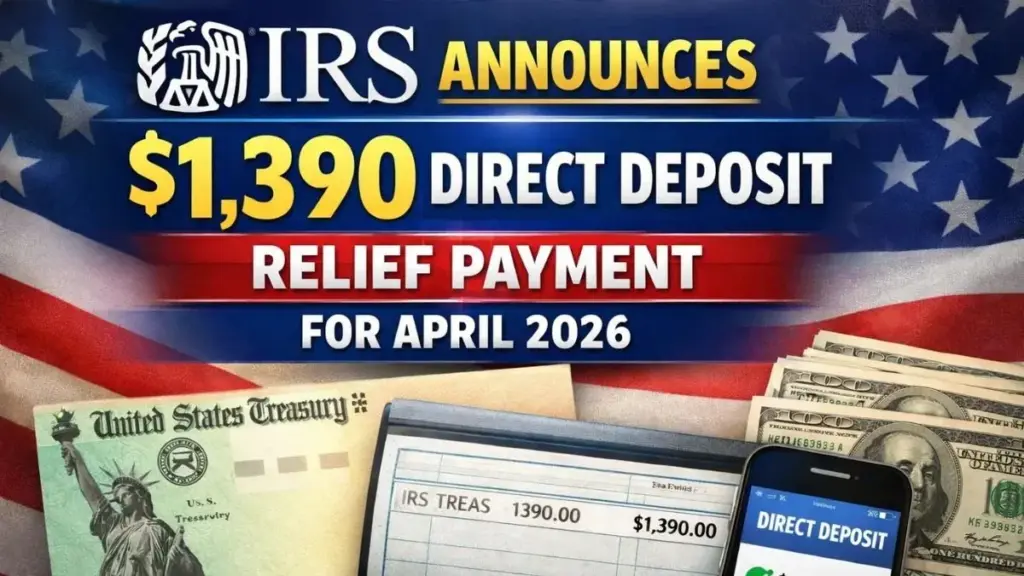
IRS Announces $1,390 Direct Deposit: Amid continued pressure from rising living costs, discussions around a potential $1,390 direct deposit relief payment from the Internal Revenue Service (IRS) have drawn significant public interest. While inflation has eased compared to earlier peaks, many households are still adjusting to higher expenses across essentials such as housing, food, and fuel. Against this backdrop, policymakers appear to be exploring more targeted financial support rather than broad-based stimulus programs.
According to reports, this proposed payment is not structured as a universal benefit but rather as a selective relief measure. It reflects a shift in economic strategy, where assistance is directed toward specific income groups. Based on available information, the IRS may rely on existing tax data to streamline processing. However, as with previous initiatives, the final rollout may depend on administrative readiness and policy clarity.

Shift from Pandemic Stimulus to Targeted Financial Support
Unlike the large-scale stimulus checks distributed during the COVID-19 period, the current proposal appears more focused in design. Earlier payments were broadly issued with fixed amounts, aiming to stimulate consumption quickly. In contrast, this relief effort is being framed as a response to ongoing cost-of-living challenges, particularly affecting low- and middle-income households.
In practical terms, this means eligibility and payout amounts may not be uniform. Instead, they could vary depending on income levels, filing status, and dependent claims. This targeted approach may improve efficiency but also introduces complexity for taxpayers trying to estimate their potential benefit. As per guidelines, individuals may need to review their tax records carefully to understand where they stand.

Income Thresholds and Filing Details Likely to Shape Eligibility
Eligibility for the proposed payment is expected to depend heavily on income brackets and tax filing categories. Based on available documents, individuals earning below certain thresholds—commonly around $75,000 annually for single filers—may qualify for full or partial benefits. Married couples filing jointly could see adjusted limits, potentially allowing for higher combined payments.
Additionally, those who have filed recent tax returns and maintain updated records with the IRS may be prioritized. Social Security recipients and taxpayers with dependents may also fall within the scope, though this may vary by case. Verification is recommended through official channels, as assumptions based on past programs may not fully apply to this initiative.

Payment Timeline and Processing Clarity Still Evolving
There is some uncertainty regarding when payments could begin, with references pointing to different timelines. While some indications suggest an April 2026 rollout, earlier processing for certain categories has also been mentioned. Typically, direct deposits are issued faster, especially for taxpayers with updated banking information already on file.
Paper checks, on the other hand, may take longer due to mailing and verification processes. In practical terms, processing speed often depends on the accuracy of tax records. Any mismatch in personal or banking details could lead to delays. Authorities are expected to complete distribution within a defined window, but timing may differ for each individual.

How Households May Use the Relief Amount
For many families, a payment of around $1,390 could provide short-term financial relief. While not designed as a long-term solution, such support may help manage immediate expenses like rent, electricity bills, or grocery costs. Economists often highlight that direct transfers to households tend to boost consumption in local markets.
A realistic example would be a working family using the amount to clear overdue utility payments or reduce outstanding credit card balances. According to a policy analyst, “Targeted cash support can ease temporary stress, but its broader impact depends on how widely it reaches and how households choose to spend it.” This highlights the dual role of such payments—supporting both individuals and local economic activity.

Checking Status and Avoiding Processing Delays
Taxpayers looking to track their payment status may rely on IRS tools such as “Get My Payment” or “Where’s My Refund.” These platforms generally require basic identification details, including Social Security Number and filing status. Ensuring that this information matches official records is essential to avoid disruptions.
In addition, individuals are advised to confirm that their bank account details and mailing addresses are up to date. Even minor discrepancies can slow down processing. Based on available information, relying on official IRS communication channels remains the safest way to track updates and avoid misinformation circulating online.
Key Limitations and What Remains Uncertain
One important aspect of this proposal is that it is not universal. Not all taxpayers may qualify, and the final amount could differ depending on individual circumstances. Income thresholds, filing status, and dependent claims are likely to influence eligibility. This makes the program more targeted but also less predictable for the general public.
There is also ongoing uncertainty regarding final approval, detailed guidelines, and execution timelines. While discussions indicate progress, policy changes may still occur before implementation. As one economist noted, “Such measures can provide relief, but they do not replace structural solutions needed to address inflation.” This underscores the temporary nature of the initiative.
Disclaimer: This article is based on publicly available information and reports regarding a proposed IRS relief payment. Details related to eligibility, payment amounts, and timelines may change as official updates are released. Readers are advised to verify information through the official IRS website or authorized government sources before making any financial decisions.